

The AI promise is one to revolutionize how your business thinks, works, and wins. It makes the possibilities seem endless, until you stumble over a tangle of messy spreadsheets, siloed systems, and data that won’t cooperate.
The hard truth is that AI has to stand on the shoulders of your data. And for most organizations, the real obstacles are about the unglamorous work of wrangling fragmented systems, patching up governance gaps, and dragging legacy, disconnected platforms into the future. In fact, 70–80% of the data modernization work that determines AI success happens before a single AI model or agent is deployed.
Let’s dig into why data maturity may be the true frontier for AI, and how you can move from a patchwork of disconnected data to a foundation that’s ready for Microsoft Fabric to deliver real, measurable value.
Data Maturity: The Real Frontier?
As organizations race to adopt AI, the same reality keeps emerging: AI is only as strong as the data foundation beneath it. If your data is scattered, inconsistent, or governed as an afterthought, even the smartest agents won’t deliver the insights or automation you expect.
At JourneyTeam, we’ve found the same patterns keep holding teams back:
- Data Fragmentation
Data lives in multiple warehouses, lakes, and marts with overlapping or conflicting content. Teams burn time hunting down the “real” numbers instead of using them. Without a unified, trusted foundation, AI has nothing reliable to learn from. - Legacy Architectures
Many core systems (on-prem databases, custom connectors, aging platforms) were never built for the scale, speed, or agility that modern AI workloads demand. These technical bottlenecks slow down every new initiative and make modernization feel overwhelming. - Overlooked Governance
Security, lineage, access controls, and ownership often get implemented too late – or not at all. The result is blind spots, inconsistent policies, compliance risk, and an inability to scale AI safely.
The Hidden Cost of Messy Data
Anyone who has spent hours reconciling spreadsheets or questioning which dashboard to trust has felt the strain of immature data practices and seen it drag down every analytics, reporting, and AI initiative. Here’s what that looks like on the ground:
- Disconnected systems and silos
Sales, finance, and operations each run their own tools, creating isolated data pockets with information stored in formats and locations that aren’t easily accessible to other teams. - Conflicting metrics across multiple BI tools
Different platforms define KPIs differently, so “revenue,” “utilization,” or “margin” change depending on who you ask. There’s no single version of the truth. - Manual, Excel-driven reporting
Countless hours are spent exporting data into Excel – copying and pasting figures from sales, finance, and operations platforms – then cleaning and reconciling the data to create a unified report. - Gaps in governance and ownership
When departments control their own data, no one is accountable for overall data stewardship, and it’s difficult to enforce security standards or track who may have accessed sensitive information.
Why Data Maturity Comes Before Intelligence: The AI Pyramid
At JourneyTeam, we use a four-layer model to illustrate why data maturity is the foundation for AI success. Starting at the bottom, each ascending layer depends on the strength and reliability of the one below it.
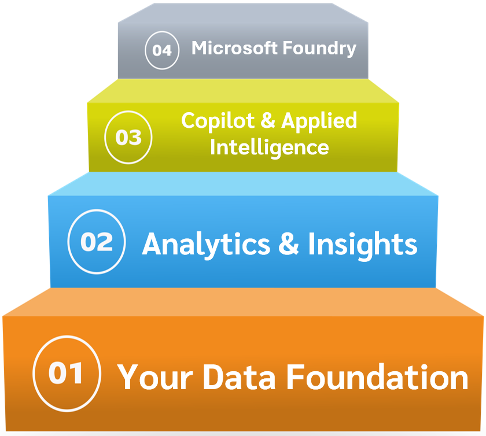
Layer 1: Unified, Trusted, and Governed Data with Microsoft Fabric
The first layer creates a unified, trusted data environment using Microsoft Fabric to integrate your ERP, CRM, and third-party systems into a centralized data lake. Data lake pipelines standardize, cleanse, and model information for use, eliminate data silos, and prepare data for analytics and AI.
Layer 2: Analytics & Insights
Once data is consolidated and governed, the second layer – Analytics and Insights – comes into play. With Fabric’s Lakehouse and Power BI integration, you can transform raw data into metrics and dashboards that clearly show business performance and give leaders confidence in the numbers.
Layer 3: Copilot & Applied Intelligence
The third layer introduces Copilot and Applied Intelligence, where AI finally delivers tangible business value. Using datasets from Fabric, Copilot uses natural language queries, predictive analytics, and contextual recommendations provide accurate answers, generate reports, and automate workflows without the risk of misinformation.
Layer 4: Microsoft Foundry
At the top of the pyramid is Microsoft Foundry (formerly known as Azure AI Foundry). It’s the tool that builds and deploys custom AI models tailored to your company’s unique processes. Foundry uses your own data and business rules, turning AI from a generic tool into a strategic differentiator.
Real-World Success: From Chaos to Clarity
It’s one thing to talk about the value of a unified data foundation, but it’s another to see it in action. JourneyTeam partnered with R.S. Hughes, a company that was struggling with an aging, on-premises reporting system. Data was scattered across platforms, and employees were spending wasted time manually extracting and reconciling information in Excel.
Their transformation was significant. Reports that once took days to compile are automated and refreshed multiple times per day. A foundation is now in place for advanced analytics and AI initiatives that can scale with the business. You can read the full R.S. Hughes case study here.
Is Your Data AI Ready?
Before you invest in new AI tools or launch your next pilot, it’s worth taking a quick self-check:
- Do you have more than one “source of truth” for core metrics?
If different teams rely on different numbers for the same KPI, your foundation isn’t unified. - How much of your reporting relies on manual Excel work?
Heavy manual processes are a sign that your data isn’t accessible or automated enough for AI. - Can you easily trace where a number came from (lineage)?
If you can’t audit or explain the origin of the data point, it’s hard to trust AI outputs or meet compliance needs. - Are security and access policies consistent across data platforms?
Inconsistent controls create risk and make it harder to scale AI responsibly. - Is there a formal data governance framework with clear ownership and processes?
Without defined roles and policies, data quality and compliance will always be at risk. - Are you monitoring and resolving data quality issues regularly?
Proactive data quality management is essential for reliable AI results.
If several answers are “no” or “I’m not sure,” your data foundation likely needs work before you’ll see real AI value. Addressing these gaps now will save time, reduce risk, and set you up for success as you scale your AI initiatives.
JourneyTeam’s Fabric SmartStart: A Practical First Step
If you’re ready to move past data chaos and set your organization up for AI success, JourneyTeam’s Fabric SmartStart is designed to help you do that without wasted time, cost overruns, or misaligned architecture. It’s a focused evaluation that provides a clear, actionable roadmap for unifying your data and preparing it to take advantage of the AI’s vast potential.