Summary: Professional services firms often struggle to scale not because of demand, but because delivery becomes inconsistent as they grow. When margins are hard to predict, capacity planning is based on guesswork, and success depends on tribal knowledge, your risk only increases. This article outlines four signs your delivery model needs a reset, and what consistent, predictable delivery can look like when workflows, data, and feedback loops work together.

Professional services organizations don’t usually struggle because demand is lacking. In fact, growth is often what exposes deeper issues: delivery becomes harder to predict, projects drift off plan, margins erode quietly, and teams rely on individual heroics to pull engagements across the finish line.
Leaders want steady, repeatable growth, but instead feel like they’re constantly juggling priorities, resources, and expectations without a clear view of what’s actually happening inside delivery. Even firms that invest in modern project management and business systems often struggle to turn those tools into a true delivery operating model.
Predictable delivery comes from standardized, repeatable delivery models built on shared workflows, unified data, and systems. Research supports this shift. McKinsey has found that organizations that standardized core processes can be 30–50% more efficient than ad hoc delivery models. For professional services firms, that can translate into more reliable margins, better planning, and growth that’s easier to sustain.
4 Signs Your Delivery Model Isn’t Predictable
Here’s 4 clear signs that your delivery model may be holding you back and why.
1. You Can’t Reliably Predict Margin When a Project Starts
When margin is unpredictable, everything becomes harder. Planning feels uncertain, delivery teams operate defensively, and leaders don’t know whether a project is profitable until it’s well underway or finished.
In many firms, estimates are still based on gut feel or informal experience. Even when historical data exists, it often lives in spreadsheets, disconnected tools, or individuals rather than a shared estimating system. Assumptions about effort, dependencies, and risk aren’t captured consistently, and once delivery begins, the estimate quickly becomes irrelevant.
This creates a familiar pattern:
- Estimates aren’t grounded in real delivery data
- Actual effort and blockers aren’t systematically captured
- Lessons learned don’t inform future scoping
- Margin surprises appear late when course correction is limited
This isn’t a people problem, it’s a system problem. Without a closed loop between estimating, delivery, and financial outcomes, each project is treated as a one-off, no matter how similar it is to the last.
Insight: Predictable delivery starts with closed loop estimating. Standardized project structures and a shared data foundation allow estimates, actuals, and financial results to reinforce one another over time. When delivery data consistently feeds back into future estimates, margin predictability improves.
2. Delivery Success Depends on Specific People
Most professional services firms recognize the pattern: project success depends on who is assigned to it. When the right people are involved, outcomes are strong. When they aren’t, delivery becomes inconsistent.
Over time, it creates operational fragility. A small group of experienced individuals becomes the backbone of delivery quality. When they’re unavailable, quality drops. When they leave, critical delivery knowledge leaves with them.
New team members feel this most. Without clear, consistent ways of working, ramp-up takes longer, mistakes repeat, and delivery outcomes vary more than they should.
Insight: Predictable delivery requires shifting the center of gravity from individual experience to repeatable delivery systems. That means codifying best practices, and standardizing core workflows. When teams operate from shared structures and a common playbook, delivery quality becomes consistent regardless of who is assigned.
3. Capacity Planning Is More Guesswork Than Forecast
Capacity planning may look solid on paper until start dates shift, utilization spikes unexpectedly, and a single new deal throws the plan out of balance. The issue is a lack of visibility. Capacity is tracked in static spreadsheets, disconnected plans, or informal conversations. By the time utilization issues surface, the data is already outdated.
As an organization grows, the problem compounds: more projects, more roles, and more interdependencies increase the cost of guesswork. What once worked through experience and intuition no longer scales.
Insight: Successful capacity planning needs to be grounded in real, shared data. When resourcing, utilization, and delivery timelines are connected through consistent workflows, leaders can plan proactively instead of making assumptions and commit to timelines confidently.
4. Data Lives Everywhere (and Nowhere Useful)
Most professional services firms have plenty of data. The problem is that it’s spread across too many systems and interpreted differently by each team. Sales, delivery, finance, and leadership all see pieces of the truth, but rarely the same picture.
As firms grow, this fragmentation only gets worse. More clients, more projects, and more tools increase complexity, not clarity. Even organizations with modern project management and business applications struggle when data structures and workflows aren’t aligned.
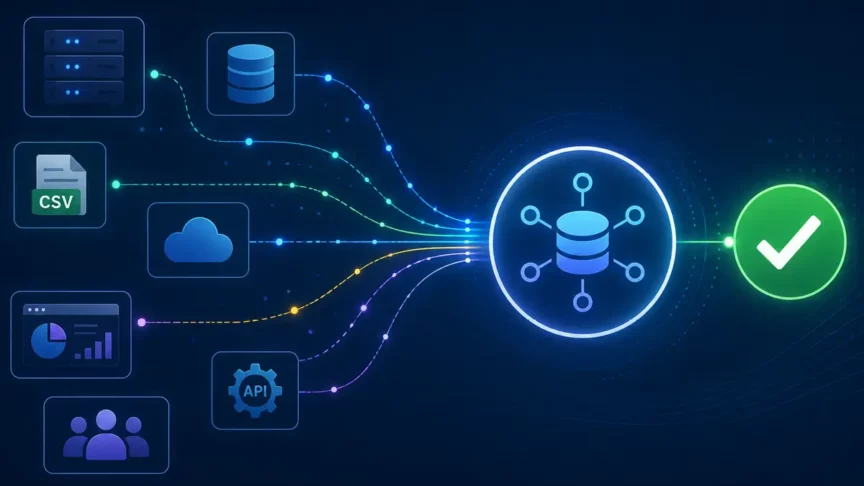
Insight: Predictable delivery requires a unified data foundation that connects sales commitments, delivery execution, and financial outcomes. When data is generated through consistent workflows and shared systems, leaders get real-time clarity, teams stay aligned, and reporting becomes automatic.
What Consistent Delivery Looks Like in Practice
A consistent delivery model isn’t about rigid processes or heavy documentation, it’s about giving every project team the same foundation to work from. Here’s what that looks like day‑to‑day:
- Common Workflows Across Every Project
Teams follow the same high‑level stages, definitions, and checkpoints. Scoping aligns with how delivery actually operates. Project setup is done the same way each time. Status updates look familiar, no matter who’s giving them. - Automatic Handoffs from Sales → Delivery → Finance
Sales doesn’t just toss projects over the fence – requirements, estimates, risks, and assumptions move seamlessly into delivery. When the work wraps, the details needed for invoicing and actuals flow into finance without someone stitching together spreadsheets. - Role‑Based Visibility for PMs, Finance, and Leaders
Consistent data makes it possible to give each team member a clear, accurate view of what they need to manage: PMs see real‑time health indicators and blockers before they escalate; finance sees margin, effort, and forecast accuracy; and leaders see overall delivery trends, staffing needs, and risks across all projects. - Built-In Feedback Loops Through Retrospectives and Real Outcomes
Delivery improves when teams consistently learn from them. Mature delivery organizations use structured retrospectives and real project outcomes to feed lessons back into estimating, scoping, and delivery playbooks. Over time, this creates a continuous improvement loop where each project makes the next one more predictable.
From Delivery Discipline to Confident Growth
JourneyTeam helps professional services organizations design predictable delivery systems not by adding tools, but by connecting them into a single operating model.
Built on Microsoft Dynamics 365 and Power Platform, our delivery framework aligns sales, delivery, resourcing, and financials so teams operate from one shared source of truth instead of disconnected spreadsheets and handoffs.
Using JourneyTeam’s proven approach, services organizations are able to:
- Translate sales assumptions directly into delivery plans
- Standardize project execution using repeatable workflows and templates
- Plan capacity and utilization realistically using live delivery and resource data
- Track margin, effort, and risk together instead of reconciling reports after the fact
- Improve forecasting and estimating over time through closed-loop delivery data
If you’re feeling the strain of inconsistent delivery, we can help you design a model that scales with clarity instead of chaos. We have a no-surprises approach, that’s centered on a proven delivery framework, transparent total cost of ownership (TCO), and a commitment to ongoing growth.
Reach Out Today
Start the conversation on how to improve your delivery model
FAQs
If delivery problems persist despite capable teams and modern tools, the issue is usually process design and system integration – not the tools themselves. A key indicator is whether outcomes vary significantly by project manager or team.Consistency problems point to missing delivery systems, not missing software.
The earliest breakdown usually occurs between sales commitments and delivery capacity. Informal handoffs and optimistic assumptions may work at smaller scale, but they fail quickly as deal volume increases – often before leadership sees clear financial warning signs. Learn more about how JourneyTeam aligns sales commitments with delivery reality.
Most organizations see early improvements within the first few delivery cycles once core workflows are standardized and data is unified. Predictability increases over time as delivery data feeds future planning, rather than requiring a disruptive, all-at-once transformation.
No. Effective standardization focuses on the critical few workflows that create clarity – like estimating, handoffs, and reporting. Teams retain flexibility in how they solve client problems while eliminating unnecessary reinvention behind the scenes. See more about how Microsoft tools and JourneyTeam support standardized workflows and automation.
Improvements fail when they depend on behavior change alone. Without systems that reinforce consistent ways of working, teams revert to old habits under pressure. Sustainable improvement requires workflows, data, and automation that make consistency the default.