Classic security boundaries are long gone─ traditional firewalls and network perimeters aren’t enough to secure businesses from today’s evolving cybersecurity threats. Attackers are finding ways to bypass weak security, and it’s only likely to increase.
It all starts with a strategy that addresses the limitations of traditional security measures and acknowledges that threats can originate from within or outside the network perimeter. Zero Trust is a security paradigm that is at the top of strategies businesses are using to slow and stop security threats.
Zero Trust isn’t just a security model— it’s the backbone of a proactive defense. And with AI at the core, you can operate with confidence, knowing your security is as intelligent and adaptive as the threats it faces.
What is Zero Trust?
Zero Trust isn’t a product, thing, technology or tool. And it’s certainly not something you need to do all at once. It’s a security philosophy that assumes everything is a threat until proven otherwise, where every transaction should be challenged.
It’s a rather simple concept that approaches data and individuals as suspect, even when they are already known and reside in what has traditionally been called the security perimeter.
Zero Trust: The 3 Principles
| Principle | Description | Applying it to your Business |
| Verify Explicitly | Authenticates and authorizes access based on all available data points, including user identity, location, device health, service or workload, data classification, and anomalies. | Users must verify who they are, using more than one method (multi-factor authentication), and devices that access the environment must be healthy (not compromised by malware). |
| Use Least-Privileged Access | Limits user access with just-in-time and just-enough-access (JIT/JEA), risk-based adaptive policies, and data protection. | Identify and protect sensitive data like a document folder for a sensitive project that allows access only to the people who need it, limiting the damage that can be caused by a compromised user account. |
| Assume Breach | Minimizes blast radius by verifying end-to-end encryption and using analytics for visibility to improve defenses. | Implement automated tools for threat detection and rapid response with access to signals across your environment and can disable accounts to reduce damage. |
What Is Zero Trust Designed to Protect?
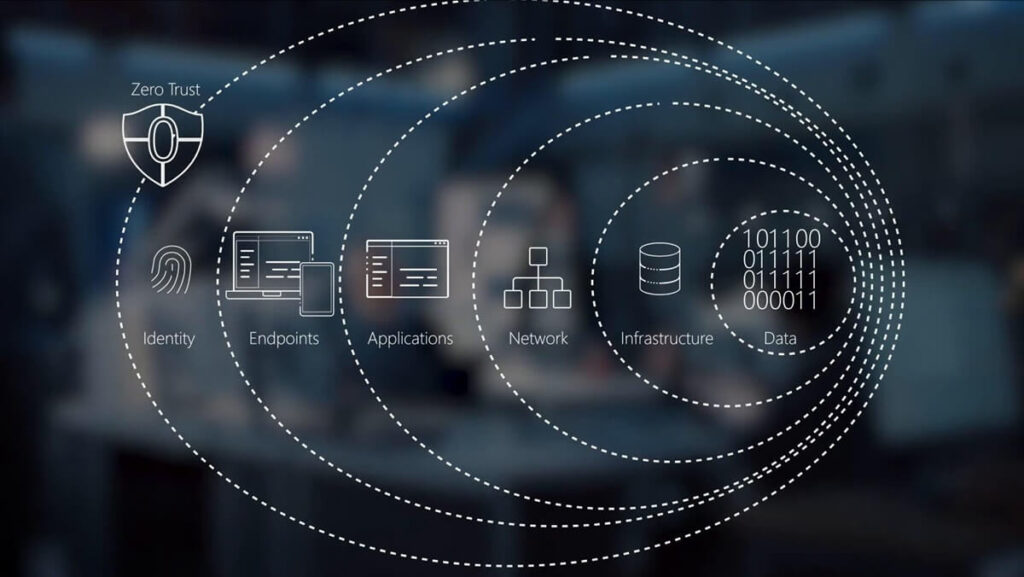
Identities
Identities refer to any human or machine entity that can access or interact with your company’s services. This includes users, computers, and service principals—essentially, anything with credentials that should be authenticated and verified.
How do I secure identities?
Zero Trust directs enforcing identity authentication through continuous verification, least privilege access, and dynamic security controls─ every user, device, and application must be authenticated using methods like multi-factor authentication (MFA). Access is also granted based on real-time risk factors like device health, location, and behavior, restricting or blocking suspicious activity.
Zero Trust is especially important in cloud-based deployment models, because many organizations don’t have their own network/infrastructure, making it even more crucial to secure their identities and devices.
Endpoints
Endpoints are physical or virtual devices that connect to a network and communicate with other systems, including laptops, desktops, mobile devices, servers, IoT devices, and even virtual machines. Endpoints serve as access points for users and applications, making them a critical part of your IT infrastructure.
How do I secure endpoints?
Instead of assuming that an endpoint is trustworthy just because it is inside the network, Zero Trust enforces strict access policies based on device identity, security posture, and real-time risk analysis. Only endpoints that meet security requirements—such as up-to-date software, encryption, and compliance with endpoint detection and response (EDR) policies—are granted access.
Applications
Applications are software programs that provide services ranging from productivity tools and ERP solutions to cloud-based services and APIs. Applications can be web-based, mobile, or on-premises, and typically store or process sensitive data.
How do I secure applications?
Instead of assuming an application is safe once inside the network, Zero Trust requires strict authentication for users, APIs, and services interacting with applications. Role-based access control (RBAC) and least privilege principles ensure users and systems only have the permissions they need.
Infrastructure
Infrastructure includes network components, servers, and data storage. These are the technical foundations and components that support your organization, including physical and virtual servers hosted in your datacenter or a cloud service.
How do I secure my infrastructure?
Zero Trust applies to infrastructure by ensuring that every request to access infrastructure is granted based on strict identity authentication, least privilege principles, and real-time security posture assessments. Micro-segmentation prevents attackers from moving laterally across infrastructure, while continuous monitoring detects anomalies such as unauthorized access attempts or configuration changes.
Data
Data is the information that is collected, stored, or processed by your systems, applications, and users. It can be structured, like information in databases and spreadsheets, or unstructured, such as emails, documents, and multimedia files. It includes sensitive information like customer details, financial records, or intellectual property.
How do I secure data?
Zero Trust applies to data by enforcing strict identity authentication, least privilege access, and encryption for both data at rest and in transit. Continuous monitoring detects unauthorized access attempts, unusual data transfers, or anomalies that could indicate a breach. Additionally, data classification and compliance controls ensure that sensitive information is categorized and protected based on its risk level.
Network
Your network is the system of interconnected devices, servers, and applications that communicate with each other over wired or wireless connections. It includes local area networks (LANs), wide area networks (WANs), wireless networks, and internet connections, such as 3G, 5G, and public Wi-Fi. Networks enable users to access applications, services, and data, whether in an office, at home, or using a mobile device.
How do I secure my network?
Micro-segmentation ensures that users and workloads only communicate with necessary resources, limiting lateral movement in case of a breach, while Network Detection and Response (NDR) continuously monitors traffic for anomalies. NDR replaces traditional VPN access with identity-based access controls and enhances security. Encryption, firewalls, and adaptive security policies further protect data in transit, ensuring that only trusted entities can communicate within the network.
How Can You Get Started?
It all depends on your organization’s security challenges, business needs, the capabilities of your network, and your internal resources. Whether applied as a major initiative, or built into smaller projects, Zero Trust should be a critical security strategy and grounding force.
You can learn more about how cybersecurity intersects with modern work in this engaging panel discussion featuring JourneyTeam’s Microsoft security experts. You’ll discover how organizations are addressing hybrid work challenges, safeguarding sensitive data, and optimizing endpoint protection all governed by Zero Trust principles.
FAQs
At JourneyTeam, as we work with our customers on their Zero Trust security initiatives, we begin by asking:
- What does your current security framework look like, and how is access secured to your environment?
- What challenges do you face in protecting data, devices, and user access, especially in remote or hybrid work environments?
- Do you have visibility into who accesses your systems, where they access them from, and what devices they’re using?
- Are there specific compliance or regulatory requirements (e.g., HIPAA, GDPR, CMMC) that influence your security strategy?
- How confident are you that your organization could detect and stop a breach or ransomware attack in real time?
If you can’t answer these questions, it’s likely you need to start thinking about your security posture and Zero Trust. It’s also important to involve key stakeholders and educate employees about the importance of Zero Trust security and their role in maintaining a supporting environment.
It’s not just the network, but the people, endpoints, policies, data, apps, and infrastructure that define, pass through, and use it. While you don’t have to implement Zero Trust all at once, it’s good to keep the big picture in mind as you plan and progress.
JourneyTeam Knows Zero Trust
Engaging an experienced partner is critical. In fact, Gartner predicts that over 60% of organizations will embrace Zero Trust principles by 2025. But more than half will fail to realize the benefits.
JourneyTeam’s AI Security Risk & Exposure Assessment is provides a clear, actionable strategy for strengthening your security posture. We assess your current environment, identify vulnerabilities, and implement a step-by-step roadmap— ensuring only trusted users and devices have access to your critical resources.
Reach Out Today!
As a Microsoft Solutions Partner for Security, you can rest assured JourneyTeam has the commitment to training and accreditation that will help you navigate the ever changing world of security concerns. Our expert guidance can help you prepare for and navigate the challenges to a secure and successful future.