Contact Center as a Service (CCaaS) is a cloud-based platform that enables organizations to manage customer interactions across voice, chat, email, and other channels without relying on on-premises infrastructure.
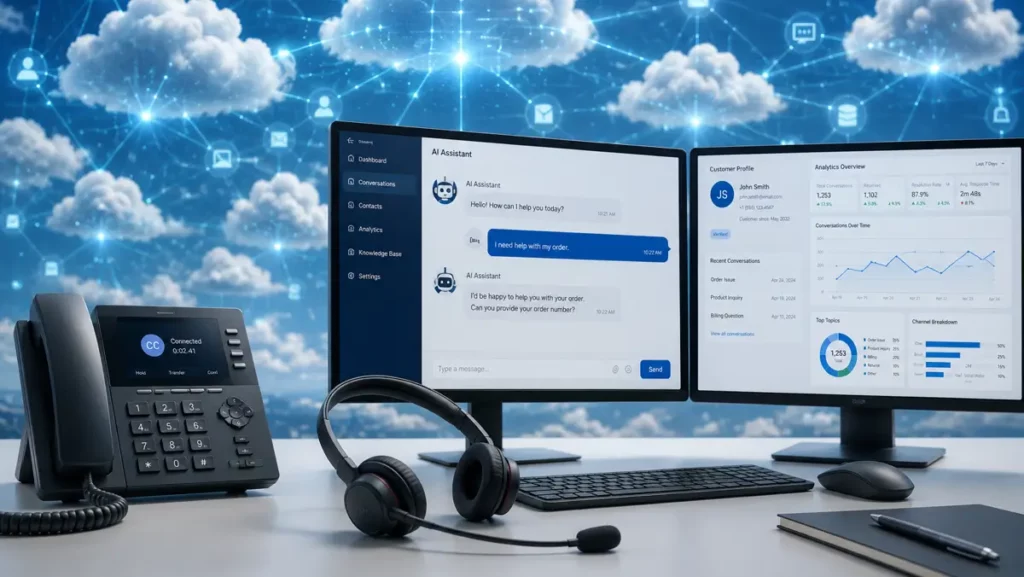
If your customer service center is struggling with disconnected systems, limited visibility, or inconsistent customer experiences, you’re not alone.
If your customer service team has ever said:
- “Can you send me the customer account again?”
- “Hold on while I pull that up.”
- “That information is in a different system.”
- “I can’t see the previous conversation.”
…you’re seeing the kinds of operational challenges that often lead organizations to evaluate Contact Center as a Service (CCaaS). Let’s look at how CCaaS can vastly improve how your customer service teams operate, while providing improved customer satisfaction in every interaction.
Why Traditional Contact Centers Fall Short
For years, most contact centers relied on technology that lived inside the business itself. Companies managed their own phone systems, call routing, recording tools, and customer service software internally.
In these environments:
- Separate tools are often used for phone support, chat, email, reporting, and customer records
- Customer interactions are spread across disconnected systems
- Agents need to manually search for information across multiple tools
As customer expectations have evolved and service teams have become more distributed. These limitations are now very visible, and organizations are looking for ways to unify systems, improve visibility, and deliver more consistent customer experiences.
What Is CCaaS?
A Contact Center as a Service (CCaaS) platform is a cloud-based system that manages customer interactions, routing, reporting, and service operations across multiple communication channels.
Instead of relying on on-premises infrastructure, CCaaS platforms are delivered over the internet. This allows organizations to manage customer conversations across multiple communication channels with a single system.
Many contact center as a service solutions include:
- Omnichannel communication support
- Customer interaction tracking
- Workforce management
- AI-assisted service tools
- Reporting and analytics
- CRM integration
- Remote agent support
Core Capabilities of a Modern CCaaS Platform
One of the biggest advantages of a CCaaS platform is visibility. In a cloud contact center environment, common functions work together in the same system. While handling a customer interaction, agents can access:
- Customer history
- Previous conversations
- Support records
- Queue information
- Knowledge articles
- Communication tools
…all from a single screen instead of jumping between applications.
In a traditional environment, a customer calls support and the agent manually searches multiple systems to understand the account history. The customer may be placed on hold while the representative gathers information from different applications.
In a CCaaS platform, customer information can appear automatically as the interaction begins. The agent can immediately see previous conversations, open service cases, communication history, and account details while the conversation is happening.
JourneyTeam’s work with LATICRETE shows how a CCaaS strategy can translate into a live, production-ready contact center built on Microsoft Dynamics 365 Contact Center.
CCaaS vs. Omnichannel Contact Centers
CCaaS and omnichannel contact centers are closely related, but they are not the same thing.
An omnichannel contact center focuses on the customer experience across multiple communication channels like phone, chat, email, text messaging, and social messaging. The goal is continuity between those conversations, so customers do not have to restart the interaction every time they switch channels.
For example, a customer might begin with a web chat, later call support, and then receive a follow-up email without needing to repeat the same information each time.
CCaaS, on the other hand, refers to the cloud-based platform used to manage those customer interactions.
In simple terms:
- Omnichannel describes the customer experience across communication channels.
- CCaaS describes the technology platform that runs and coordinates those interactions.
Today, most contact center as a service solutions include omnichannel capabilities as part of the overall platform. In fact, omnichannel support is one of the main reasons many organizations begin evaluating CCaaS in the first place.
CCaaS vs UCaaS
UCaaS (Unified Communications as a Service) is another cloud-based platform, but it focuses on internal communication such as business phone systems, meetings, and collaboration.
While UCaaS supports employee communication, CCaaS is designed specifically for structured customer interactions that require routing, tracking, reporting, and service-level management.
Many organizations use both:
- CCaaS for customer service interactions
- UCaaS for internal collaboration
The two systems often work together to support both internal communication and external customer engagement.
Where AI Fits Into CCaaS
AI is quickly becoming part of everyday customer service workflows inside CCaaS platforms. For example, instead of requiring agents to manually document every customer interaction after a call ends, AI can automatically generate conversation summaries and interaction notes.
During live conversations, AI tools can:
- Surface relevant customer information
- Suggest responses and/or knowledge articles
- Recommend next actions
All based on what the customer is discussing in real time.
Behind the scenes, supervisors can use AI to:
- See recurring customer issues
- Identify service trends
- Surface staffing challenges, or interactions that may require additional review or coaching
Most organizations are still balancing automation with human support. Chatbots and self-service tools can help handle routine questions, but many customer interactions still require empathy, judgment, escalation handling, and problem-solving that only humans can provide.
Why CRM Integration Matters in CCaaS
Both CRM and CCaaS are centered around customer data but without integration, that data becomes fragmented and difficult to use effectively.
A CRM system stores customer and account information, while a CCaaS platform manages customer communications and contact center activity. When those systems operate separately, agents often waste time jumping between applications trying to gather information during customer interactions.
When CCaaS and CRM platforms are integrated:
- Customer information can often appear automatically as interactions are received
- Agents can access account details, service history, and past conversations in real time
- Reporting and analytics become more accurate
Evaluate Your Contact Center Strategy with JourneyTeam
At JourneyTeam, we help organizations evaluate how customer service operations, CRM systems, communication platforms, and AI capabilities work together across the broader business environment. Check out our new eBook, where we explain how we help customers move from a patched-together service environment to a unified contact center.
Whether you are just beginning to explore CCaaS or trying to improve an existing contact center setup, the goal is usually the same: giving teams better visibility, better coordination, and a better customer experience. Our Contact Center Optimization Workshop is a great first step elevate your service operations.