What Is Contact Center Modernization?
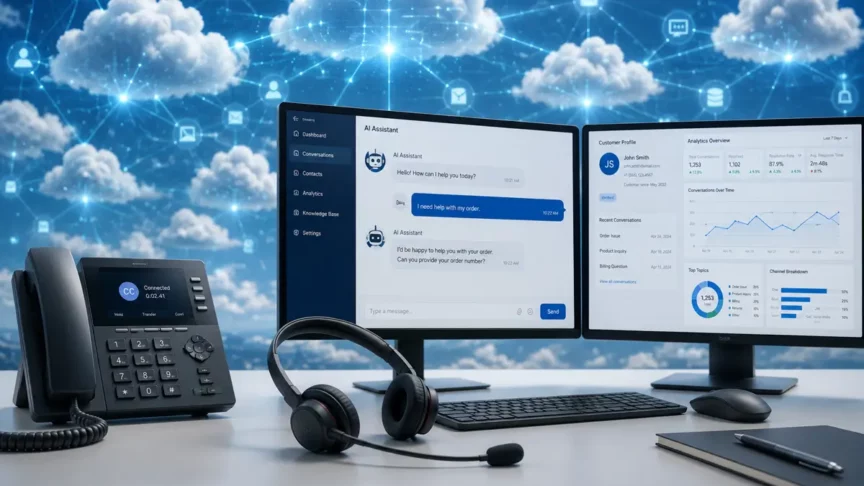
Contact center modernization isn’t about replacing a phone system or adding another digital channel. It’s the process of improving how customer service operations, routing, reporting, communication channels, CRM systems, and AI operate together.
Modernization addresses those problems by creating a more connected, consistent operational model—one where customer context flows between channels, supervisors have real-time visibility, and AI has the structured data it needs to be effective.
Signs Your Contact Center Needs Modernization
Many organizations decide to modernize the contact center when service becomes harder to deliver, manage, and improve. The warning signs are usually operational, not strategic. Common signs include:
- Agents switch between too many systems to handle one customer issue.
- Customers repeat information across channels because context does not carry over.
- Reporting is fragmented across platforms, limiting visibility into performance.
- Service quality varies by channel, creating inconsistent customer experiences.
- Supervisors step in manually to manage queues, routing, and escalations.
- AI adoption stalls because data, workflows, and integrations are not ready.
When these problems become routine, contact center modernization becomes necessary to improve efficiency, service consistency, and readiness for AI.
Key Components of a Modern Contact Center
A modern contact center is built on a set of core operational capabilities that work together rather than independently. While specific technology choices vary, most successful modernization efforts address the same foundational areas:
- Omnichannel engagement
Manage customer interactions through voice, chat, email, messaging, and social channels through a unified routing and engagement model. - CRM integration
Service teams need customer history, account details, and case context available during live interactions without switching between systems. - AI and automation
AI reduces repetitive work and supports faster, more consistent service delivery through conversation summaries and suggested responses. - Reporting and analytics
Real-time and historical visibility into queue health, routing behavior, workload distribution, and service levels. - Workforce visibility
Understanding how work moves through the operation.
The challenge is knowing where to start—and in what order—so each phase builds on the one before it rather than creating new disconnects. That’s where a phased modernization roadmap becomes useful.
A 6-Step Roadmap for Contact Center Modernization
Modernization works best as a phased effort because contact center systems, workflows, and data dependencies need to be aligned in the right order. A clear roadmap helps teams reduce disruption and improve operations step by step.
Step 1: Stabilize the Service Environment
One of the biggest misconceptions about contact center modernization is that it starts with technology selection. Not so. Start by mapping current workflows to reveal gaps between documented processes and how work actually happens. It’s also the stage where you should evaluate whether your current infrastructure (on-premises vs. cloud) can support the changes ahead.
Start by identifying the friction points:
- Where requests enter the environment.
- Which systems agents rely on most heavily.
- Where duplicate data entry occurs.
- Which queues experience the most instability.
- Where supervisors intervene manually.
Step 2: Create One Intake and Routing Model
One of the biggest problems inside aging contact centers is inconsistency between communication channels. Customers often receive entirely different experiences depending on whether they contact support through phone, chat, email, or messaging platforms.
Step 2 focuses on grouping interactions by work type rather than by channel. Billing issues, technical support requests, order updates, and escalations often need similar handling regardless of whether they arrive through voice, chat, or email.
Once those work patterns become visible, teams can begin identifying:
- Where routing exceptions accumulated over time.
- Which queues require constant supervisor involvement.
- Where escalations behave differently by channel.
- Where transfers happen most frequently.
The objective is to create routing logic that is not just offering multiple channels but routing them through a consistent operational model.
Step 3: Centralize Customer Context
Customers can immediately tell when service systems are disconnected. They hear:
- “Can you repeat your account information?”
- “Hold on while I pull that up.”
- “I can’t see the previous interaction.”
The third modernization step is about reducing the number of systems that agents need to access during live conversations. That usually means bringing customer history, service cases, CRM data, communication timelines, and knowledge content together inside the same environment.
Evaluate the information agents need to be visible during an interaction and which systems create the most disruption when context is missing.
That often leads to decisions around:
- Surfacing customer history automatically.
- Connecting service activity with CRM records.
- Reducing duplicate data entry.
- Standardizing visibility across communication channels.
The objective is to create a more connected agent experience, so conversations continue smoothly instead of restarting every time systems change.
Step 4: Improve Operational Visibility
Most contact centers already have reporting. The problem is that many supervisors still discover operational issues too late. A dashboard may show that service levels declined yesterday, but it might not explain where routing pressure started building, which queue became unstable first, or why transfer rates suddenly increased.
Step 4 focuses on making service conditions easier to interpret in real time. Start by identifying which metrics actually influence daily service decisions and where supervisors lack visibility into developing problems:
- Queue backlogs
- Routing patterns
- Workload balancing
- Transfer behavior
- SLA risk
As those patterns become clearer, you can establish thresholds for when intervention is needed and what actions supervisors should take before performance declines further.
The goal is shifting operations from reactive management to earlier decision making. It also sets the stage for future automation because organizations begin understanding where manual effort, repetitive work, and workflow bottlenecks exist inside the operation.
Step 5: Introduce AI Into Targeted Workflows
The strongest AI rollouts usually begin much smaller than many organizations expect. Instead of trying to automate entire customer journeys immediately, most successful teams start with operational tasks that create repetitive administrative work for agents and supervisors.
Conversation summaries are often one of the first areas organizations introduce, because they reduce the post-call documentation effort without dramatically changing the workflow itself. Suggested responses, knowledge recommendations, and sentiment insights often follow because they improve agent support inside existing processes.
This phased approach matters because it gives organizations time to evaluate:
- Data quality
- Workflow consistency
- Routing stability
- User adoption
- Confidence in AI outputs
As faith in the environment grows, organizations can gradually expand into more advanced automation scenarios like intelligent routing, self-service containment, and AI-assisted workflow execution. The operational foundation still matters more than the AI feature itself.
Step 6: Expand Automation and Continuous Optimization
The strongest contact centers continue adjusting and refining operations long after the initial deployment is complete. Queue behavior changes. Customer expectations shift. New channels appear. Staffing models fluctuate. AI capabilities improve. Routing logic expands over time. Without ongoing service governance, even modern environments can slowly become fragmented again.
This phase usually focuses on refining operational performance continuously through activities like:
- Adjusting routing effectiveness
- Balancing workloads
- Optimizing self-service experiences
- Improving AI-assisted workflows
- Reviewing queue health trends
- Identifying new automation opportunities
Many organizations also establish more formal operational governance during this stage, so workflow changes, routing updates, escalation logic, and AI usage remain controlled as the environment evolves.
For a real-world example of contact center modernization moving from planning to production, see how JourneyTeam supported LATICRETE through its Dynamics 365 Contact Center go-live.
Build a Practical Modernization Roadmap with JourneyTeam
Successful contact center transformation usually happens in phases rather than through a single deployment project. At JourneyTeam, we help organizations modernize customer service operations with a phased approach built on Microsoft technologies.
Our focus isn’t just implementation. It’s helping organizations create a connected operational model that continues improving long after deployment. Because successful contact center modernization is not about adding more disconnected technology—it’s about building a customer service operation that runs as a unified whole.
Discuss Your Contact Center Modernization Path
Let’s have a conversation about how we can help your organization reimagine its customer experience.